Gerhard Richter – Ideology and Politics
On 12th October 1986 Gerhard Richter wrote in a diary note:
‘What shall I paint? How shall I paint?’ (Richter, 1995, p. 129)
That Richter, who had been painting at that time for over thirty years with a great deal of success, was still asking these questions, demonstrates the difficulties that the weight of painting’s history, the advent of photography and the widespread availability of images today present to even the most accomplished painter. This series of six essays will examine the role that Gerhard Richter’s painting has played in contemporary art in order to address these questions and more specifically:
If Richter’s work demonstrated how painting might function after photography, how might painting function after Richter?
This essay will examine Richter’s approach to painting in the light of his distaste for ideologies and focus on the fifteen paintings collectively called October 18, 1977. The paintings were of four members of the Baader-Meinhof gang; part of a larger social activist/terrorist group called the Red Army Faction (RAF) operating in Germany in the late sixties and seventies, who were responsible for a series of terrorist acts, including arson, bank robbery, kidnapping, bombing and murder.
Richter was born in Dresden 1932 and brought up nearby. His early life would therefore have been directly influenced by two pernicious ideologies of the twentieth century, Nazism and communism. Richter also had direct personal, as well as political, experience of these ideologies. His mother’s brother, Rudi, died a young Nazi officer, and his aunt Marianne, a schizophrenic, was forcibly sterilised under a Nazi program. Richter escaped to West Germany in 1961, a few months before the Berlin Wall was erected. The ideology he left behind subsequently painted over two of his works: a wall painting ("Communion with Picasso", 1955) painted in the refectory of the Dresden Academy of Arts where Richter had studied for his B.A., and a mural entitled Lebensfreude in the German Hygienic Museum. It can be argued that throughout his career Richter continually returned this compliment by metaphorically painting over the idea of ideology and ‘isms’.
Richter’s early distaste for ideology was made clear in an interview with Hans-Ulrich Obrist in 1993:
‘By the age of sixteen or seventeen I was absolutely clear there is no God – an alarming discovery to me, after my Christian upbringing. By that time, my fundamental aversion to all beliefs and ideologies was fully developed. (Richter, 1995, p. 251)
The heterogeneity of Richter’s painting, embracing, as it does, portraiture, landscape, townscapes, aeroplanes, monochrome, abstracts, still life, and paintings influenced by painters such as Titian and Caspar David Friedrich, could be seen as a reaction to the limitations imposed by ideologies (and in particular the communist one from which Richter had escaped) and also illustrates Richter’s reluctance to succumb to the demands of the art market to fit within a particular ‘ism’ and the constraints such categorisation can bring. This heterogeneity can also be seen as a response to the belief in the 1960s that painting was exhausted; that it had said all that it had to say and had lost its relevance to society and the art world; the elusiveness provided by the different ‘suits’[1] that Richter wore and the indistinct look of his work and its connection to photography made it difficult for his work to be deemed irrelevant. This was shown in an interview with Wolfgang Pehnt in 1984:
‘WP: You’ve done a great deal of work with photography. For instance, whenever you’ve painted a portrait, it hasn’t been a portrait of the sitter but a portrait of the photograph of a sitter.
GR: Yes, because painting at that time was so much called into question, cast into such disrepute. I couldn’t have a straightforward relationship with painting. That’s how it was at the time: anyone who was painting was on the wrong track anyway.’ (Richter, 1995, p. 114)
And in an interview with Jonas Storsve 1991:
‘But I clearly remember this anti-painting mood did exist. At the end of the 1960s the art scene underwent its great politicisation. Painting was taboo because it had no ‘social relevance’ and was therefore a bourgeois thing.’ (Richter, 1995, p. 223)
This frequent changing of ‘suits’ in Richter’s early work brought with it the criticism of inconsistency, which Richter spoke about in an interview with Sabine Schütz in 1990:
SS: Quite early on you were described as ‘inconsistent’ because you were always swapping levels, both in your subject matter and, even more, in your style. You have described yourself as ‘uncertain’. Or is some of it about proving to yourself and to others that you can do anything?
GR: No it isn’t that….Inconsistency is simply a consequence of uncertainty, which I certainly do tend to suffer from – but then I also regard it as inevitable and necessary.
SS: So perhaps uncertainty is the overriding theme?
GR: Maybe. At all events, uncertainty is part of me; it’s a basic premise of my work. After all, we have no objective justification for feeling certain about anything. Certainty is for fools and liars.’ (Richter, 1995, p. 215)
Uncertainty is not a trait of ideologies.
Having developed a fundamental aversion to beliefs and ideologies at the age of sixteen or seventeen, Richter continued to demonstrate that belief in his writing and interviews:
from his notes in 1989:
‘My denunciation of ideology: I lack the means to investigate this. Without a doubt ideologies are harmful, and we must take them very seriously: as behaviour, and not for their content (in content they are all equally false.’ (Richter, 1995, p. 177)
October 18th 1977 was the day that the bodies of two of the members of the Baader-Meinhof gang, Andreas Baader and Gudrun Ensslin, were discovered in their cells at Stammheim high-security prison, near Stuttgart. Two other members of the group had also died in Stammheim: Holger Meins from a hunger strike three years earlier, and Ulrike Meinhof, who was found hanging in her cell on May 9th 1976. It was more than ten years before Richter began painting the collection of fifteen paintings collectively entitled October 18, 1977 that was first exhibited in Krefeld, near Cologne between February 12th and April 4th 1989. What had made him decide to paint this subject more than ten years after the events depicted? Richter himself is non-committal:
‘I had kept a number of photographs for years, under the heading of unfinished business. It’s hard to say how it came about late in 1987 my interest revived..’ (Richter, 1995, p. 183), conversation with Jan Thorn Prikker, 1989.
As noted above, Richter had underlined uncertainty as a basic premise for his work, and the subject of the Baader-Meinhof gang, whilst on the surface presenting the certainties of conflicting ideologies, left and right, under the surface it presented a host of uncertainties: the reasons for the radicalisation of what were mostly middle-class citizens; why these reasons largely went unquestioned; the validity of the harsh treatment of the group once imprisoned; murder or suicide etc. The subject may therefore have had a resonance for Richter ‘s own uncertainty about what to paint and how to paint it, expressed some eighteen months before he began work on the October 18, 1977 collection, and may have offered him the opportunity to demonstrate the relevance of painting, and in particular, his approach to painting, to the issues facing society at that time, as embodied in the Baader-Meinhof story. Certainly it presented an opportunity for him to express his views on the futility of ideologies; but it also gave him the opportunity to present the losses, rather than the promised gains, that result from ideological thinking.
Richter had gathered many hundreds of photographs from various sources, including the press, the police and members of the underground. He had originally intended to paint many more than fifteen pictures and cover more of the RAF story. In the end he painted:
1] ‘...it’s really wrong to talk about frequent changes of style in my work. You wear different suits on different occasions; that has nothing to do with style.’ Richter, G. (1995). The Daily Practice of Painting, p229

Youth Portrait – a picture of Ulrike Meinhof that had actually been taken in 1970 but which Richter changed to look like a younger, more innocent subject, perhaps to focus more on the human aspect of the events by providing a contrast with the innocence lost depicted in the other paintings;


Arrest 1 and Arrest 2 – paintings of the arrest of Holger Meins showing him kneeling naked in front of an armoured vehicle;
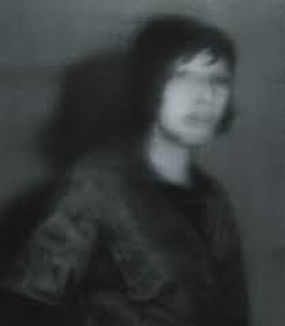

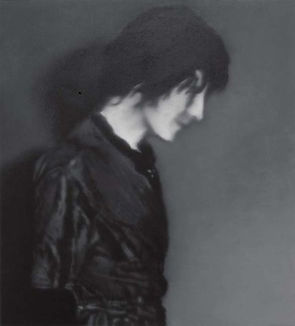
Confrontation 1, Confrontation 2 and Confrontation 3 – paintings of Gudrun Ensslin half turned towards the viewer, facing the viewer and lastly in profile, which, with movement provided when the three paintings are seen together, seems like a departure;

Hanged – a picture of Gudrun Ensslin hanging from a metal grill in her cell;

Cell – a painting of Andreas Baader’s cell with his disembodied coat hanging to the left;

Record Player: - a picture of the record player in Baader’s cell that was allegedly used to hide the gun which killed him;

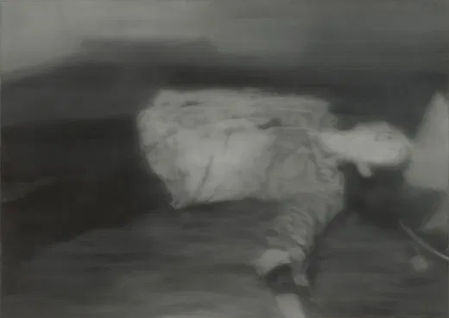
Man Shot Down 1, Man Shot Down 2 – paintings of Andreas Baader lying dead on the floor of his cell;
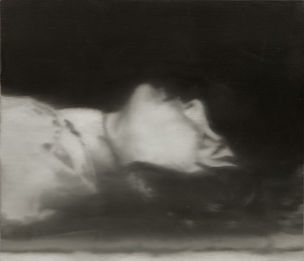


Dead, Dead and Dead – three paintings of Gudrun Ensslin lying on the floor of her cell with the rope that hanged her still around her neck;

Funeral – a picture of Baader’s, Ensslin’s and Jan-Carl Raspe’s[1] coffins being carried through a cemetery amongst a crowd of mourners and journalists.
With the exception of Funeral, Cell and Record Player, these paintings depict the subjects alone, stripped of belief and at the point of departure. They show people diminished; literally, in the three paintings of Gudrun Ensslin lying on the floor of her cell, as each canvas becomes smaller and the image more indistinct. From the many hundreds of photographs he gathered on the subject, Richter chose to focus on the isolation of the human condition and how, when humanity is overlooked for the sake of ideology, we are left with nothing. This is emphasised by the uniform greyness of the paintings; ideologies are often grey and colourless.
Looking at a photograph is a form of grieving; a photograph captures an instant, and is made in an instant, and always represents a moment lost. The viewer is therefore presented with an aporia; he is stuck in time, unable to move on. Contemplation and resolution are difficult. A painting, because it inherently contains time, and, when viewed, is an experience of something present rather than something lost, can move the viewer through and beyond the moment of loss. Richter’s technique in the October 18, 1977 paintings of blurring and making the subject matter uncertain and indistinct helps to provide this movement but it also serves another purpose. The blurring exposes the unsaid; the unwillingness to confront the paradoxical human elements of the story; the compassion and respect for the braveness and determination of the members of the group set against the terrible things they had done. The blurring also introduces a distance, pushing the viewer away and then inviting him in, thereby helping to provide the time and space necessary for proper consideration and understanding of the events depicted that can help move the viewer forward.
Richter talked about this focus on the human in an interview with Sabine Schütz in 1990 that seems to speak directly to the October 18, 1977 works:
‘SS: You constantly stress your anti-ideological position. What do you mean by ideology?
GR: One contemporary example is the ideology of socialism in the GDR. People believe in such a thing against all reason – and make themselves and other people unhappy. It’s a kind of psychological illness, and apparently an incurable one. It would be a lot better if we could know ourselves, see what we’re really like, what we’re capable of, why we kill, why we are good – and above all what is feasible. Instead of that we ‘believe’. That is a luxury we can no longer afford, on this endangered globe.’ (Richter, 1995, p. 212).
On 7th January 1988 Richter wrote in his notes:
‘My profound distaste for all claims to possess the truth, and for all ideologies – a distaste that I have often expressed with varying degrees of skill (and which has shown itself so clearly in my pictures, in my way of working, in my whole attitude that I myself have repeatedly ascribed it to an innate lack of structural capacity, or of courage, or of strength, or of the formal impulse, or of potency, or of creativity) – this now receives confirmation from such people as the physicist Dürr, the evolutionary scientist Riedland, and Konrad Lorenz, who say that our sole hope of survival lies in the ‘gropings of human self-doubt’: in our awareness of our own limitations. And so I hope that my ‘incapacity’ – the scepticism that stands in for capacity – may after all turn out to be an important ‘modern’ strategy for humankind. Even more than before, therefore, I can assume (and, where possible, proclaim) that the absurdity (and inhumanity) of all ideology is a given fact.’ (Richter, 1995, pp. 170-171).
Richter’s ‘incapacity’; his blurring; the uncertainty and doubt inherent in his restless changing of ‘suits’ (it’s really wrong to talk about frequent changes of style in my work. You wear different suits on different occasions; that has nothing to do with style.’ Richter, G. (1995). The Daily Practice of Painting, p229), are pertinent to the uncertainties of modern life where nothing is quite as it seems. They are particularly relevant to the subject of the Baader-Meinhof gang, with its shifting ambiguities and unresolved issues. Paradoxically, his October 18, 1977 paintings do possess truth; the blunt truth of death, the truth of the futility and ultimate alienation of ideological thinking, and the truth of our capacity for compassion and for grief, and that understanding the madness of the human condition is more important than applying the straightjacket of ideology.
In the same year that Richter painted the works for October 18, 1977, he painted Betty, a portrait of his sitting daughter turned away from the viewer and wearing a white top with a rich red pattern. The work was untypical of Richter’s work at that time, and it is almost as if the grim, grey Baader-Meinhof paintings required a release, a respite, something colourful and affirming, and that the focus on the events of October 1977 was, at times for Richter, difficult to bear. The fact that his daughter is turned away from the viewer implies that we can never be certain of fully knowing someone, even our offspring, and that the sons and daughters that died in Stammheim prison and the reasons for their deaths will never be fully understood.
By painting the controversial subject of the Baader-Meinhof gang, Richter showed the fire and passion of the voyeur and the artist; and in his meticulous and thoughtful treatment of the subject he also showed the ice of the puritan. These qualities are evident throughout Richter’s work. They form a powerful and moving combination that creates a tension and uncertainty that is mirrored in today’s society, and makes Richter’s work of continuing relevance and impact in contemporary art.
Bibliography
Benjamin, A. (2004). Disclosing Spaces: On Painting. Manchester, UK: Clinamen Press.
Jean-Philippe Antoine, G. K. Gerhard Richter. Paris, France: Editions Des Voir.
Richter, G. (1995). The Daily Practice of Painting. (H.-U. Obrist, Ed., & D. Britt, Trans.) London: Thames and Hudson.
Schjeldahl, P. (1990 йил April). Death and the Painter. Art In America 4 , 252 - 256.