.

Science and Art (SCART) - Making the Connection
“Theory has nothing to do with a work of art. Pictures which are interpretable, and which contain a meaning, are bad pictures. A picture presents itself as the Unmanageable, the Illogical, the Meaningless. It demonstrates the endless multiplicity of aspects; it takes away our certainty, because it deprives a thing of its meaning and its name. It shows us the thing in all the manifold significance and infinite variety that preclude the emergence of any single meaning and view. (Richter, 1995, p. 35).
Introduction
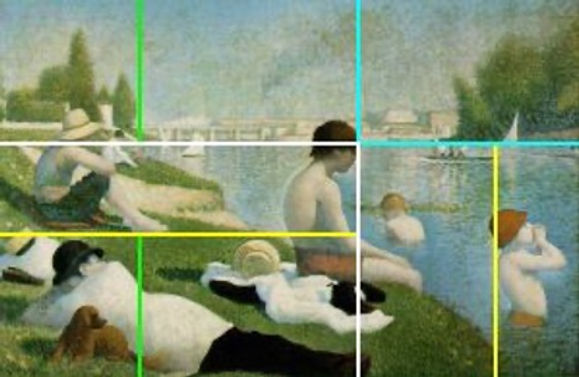
This essay, whilst recognising the value of philosophy in providing an informative and potentially inspiring art discourse, discusses whether there is perhaps too much emphasis placed on philosophy in contemporary art, and whether there may be other disciplines, and in particular, quantum mechanics, and the principle of uncertainty that underpins quantum mechanics, that might also provide insight and inspiration. Both physicists and philosophers have for a long time avoided the philosophical implications of quantum mechanics, but new branches of philosophy such as Speculative Realism and Object Oriented Ontology have arisen recently to address this issue. Quantum mechanics seems worthy of consideration in this context since it addresses some of the fundamental issues of philosophy and art, such as the nature of matter and reality, the subject/object relationship and role of the observer, and sits well with Richter’s view of pictures quoted above. Gabriel Catren, who has a PhD in both physics and philosophy, has recently proposed a new ontology of the object. Catren suggests that philosophy and art have become ‘desutured’ from, but conditioned by, science, although the two disciplines have a synchronous relationship. He suggests that the same relationship exists between concepts (thought) and precepts (non-thought). and that art deals in the space between thought and non-thought as they come into contact with each other. An example of this conditioning of art by science is the use of the aesthetically pleasing golden section (approximated by the Fibonacci sequence)[1] which occurs in many natural forms such as shell spirals, leaf patterns, and the human face and body and which has been used extensively in architecture (e.g. The Parthenon, St Pauls, Notre Dame). Leonardo Da Vinci used it extensively: (for example in the dimensions of the room and the table in The Last Supper)
as have more recent painters such as Seurat (in The Bathers)
Other examples include the development of lenses, the use of chemistry in the development of modern paints, modern technological inventions such as the video camera, the influence of science in Keith Tyson’s painting, etc. etc.
The essay starts by considering what may have been lost to painting (and therefore reclaimed) because, amongst other things, of the changing way that it has been taught and the influence of Greenbergian doctrines. There is then an investigation of some of the key elements of quantum mechanics and a summary of the recent work on the ontology of the object by Gabriel Catren. An attempt is then made to apply these insights to address and analyse the practice and paintings of Philip Guston as well as discussing possible uses in my own practice.
Painting’s Loss
In the modernist and then post-modernist (and allegedly post-medium-specific) age, where, in art, ‘anything goes’; it is ironic that many of the possibilities of painting became off-limits. This was partly due to the belief that many of painting’s previous functions have been replaced by the rise of mechanical, and, more recently, digital reproduction, and partly due to the fall-out of modernist, and in particular, Greenbergian concepts of medium-specificity. It can also be argued that it is partly due to the way that art has been taught, since what contemporary artists do is inevitably influenced by their art-school education. This is discussed in Thierry de Duve’s essay ‘ When Form Has Become Attitude – and Beyond’ (Duve, 1994, pp. 23-40), where de Duve breaks the teaching of art into three main models; the Academy Model, the Bauhaus Model and the Current Model. He gives each model three main characteristics in order to highlight the differences between them: for the Academy Model, talent, metier and imitation; for the Bauhaus Model, creativity, medium and invention, and for the Current Model, attitude, practice and deconstruction. He explores the factors that influenced the changes and the effects these changes had, without making any recommendations as to the way forward. For a painter, there are both losses and gains from these changes. The move from the Academy Model meant the disappearance of the apprenticeship system and the corresponding focus on metier or technique. Much of the knowledge which had accumulated over several hundred years and which was passed on via the apprenticeship system was lost. Whilst painting was freed from the model of imitation (with the subsequent proliferation of many different movements and styles), as modernism progressed, the definition of what painting was became increasingly narrow; with figuration, and even the space in which representation might be possible, very much out of fashion. Painters active in the 1950s who did not subscribe to modernist tenets, were faced with the difficulty of how to make their work seem relevant and contemporary.
In the sixties painting retreated, although there were artists such as Gerhard Richter and Philip Guston who believed that whilst painting’s hegemony had irrevocably gone, painting still mattered. If painting seeks to solve an insoluble problem, then both Richter and Guston, rather than find something that seemed to work and stick with it like some of their contemporaries (Lichtenstein for example,), constantly sought new ways of solving the problem. With Lichtenstein’s body of work there is not the same sense of movement as when looking at Richter’s or Guston’s, of the painter’s intent that each painting should in some way change the painter. Richter did several key things to address the problem of how to continue to paint in an anti-painting art world that the retreat of painting raised for painters in the 1960s.
The first thing seems to have been his appreciation of the importance of an underlying conceptual framework. Richter’s realisation in the 1960s that photography not only needed to be addressed (if not confronted), but could also form the conceptual basis for his painting was, by his own admission, the key turning point in his career. Firstly photography helped to legitimise his work. Secondly it offered him a wealth of subject matter; not just the photographs that he acquired or took, but also the subject of photography itself, its science and its processes, as in the colour charts and grey paintings. Thirdly it enabled Richter to develop a distinctive style; most obviously via the blur (although if the photographic blur is by and large an accident, a painting is rarely blurred for this reason), but also because his avowed intent to paint photographs resulted in something which seemed to occupy a space between painting and photography. This gave his paintings a strange, distinctive look, and seems a good example of art dealing in the space between percept (the photograph) and concept (the painting). Fourthly it enabled Richter to comment politically (for example the Baader Meinhof paintings) and to maintain a critical relationship with the world around him.
The second thing was his focus on technique and its development; (an example being the title of the book of his notes and interviews - The Daily Practice of Painting – my italics). This helped Richter not only to embrace the many different subjects that photography offered, but also allowed him to develop the distinctive quasi-photographic look to his paintings.
The third thing was Richter’s determination to follow his own path in the face of strong opposition and to be continually asking questions; whether these were conceptual questions (even in 1995, after many years of success, Richter was writing: (‘What shall I paint? How shall I paint?’ (Richter, 1995, p. 129), or questions of the materials being used.
These things helped to demonstrate how the things lost to painting might be partially reclaimed, (without advocating an impossible return to the Academy Model); through a combination of technique, a focus on the medium (in opposition/collaboration with photography), the use of a conceptual framework and an acknowledgment of the aesthetic in painting. And given that photography was originally enabled by science, via lens technology and chemistry, Richter’s work can also be seen as an example of how science that was originally deemed to contribute to painting’s loss can be turned into a positive influence
My study of Richter in the first year of my MFA highlighted the absence of a relevant conceptual framework for my own work, and I felt that in order for my work to move forward in a coherent way, I needed to question what this might be. One of the things that the move to what de Duve describes as the Current Model of teaching art has added to art education is the focus on the continental writers/philosophers such as Deleuze, Derrida, Lacan etc. This occurred at roughly the same time as the rise in conceptual art and the dematerialisation of the art object, which de Duve references in the title of his essay taken from the exhibition where conceptual art was first acknowledged by a major art institution (‘When Form Becomes Attitude’ at the Kunsthalle in Bern). There are several reasons for the focus on philosophy in contemporary art education: a framework for some conceptual art; an imbrication with political issues, (and in particular a critique of capitalism); it may also be a question of contemporaneity, since, as Richter writes, “It is the tradition of Art Schools that they are always in the present” (Richter, 1995, p. 105). The main reason is the rich interplay between philosophy and art, and the rich resource that philosophy provides to the artist through its thinking and writing. A criticism that can be levelled at art (schools) today is that there is too much focus on philosophy. As Adrian Rifkin writes: ‘…art seems more and more to exist for, or by virtue of, the quality of the philosophical discourse that can be directed at it….so often today, an indiscreet interpretation of art is an effect of philosophy’s narcissistic requirements for representation of its own power..’. (Adrian Rifkin, 1999, pp. 40-41). Although there is some element of truth in this statement, it is perhaps an extreme view that highlights the overuse of philosophy in art. The focus of this essay however is not to debate this issue but to discuss how the idea of epistemological flattening, where not only philosophy, but other disciplines such as mathematics, psychology, geology, biology and physics, can be brought into a reciprocal process of cross-fertilisation with art. In order to understand how this might work with respect to physics, there follows an exploration of the basic principles of quantum physics and new ideas about the ontology of the object.
Quantum Mechanics and The Nature of the Object
At the time that the concepts at the heart of philosophical discussion about the nature of the object that were first documented in the Platonic ideas and forms: the ‘noumenon’ – an object that is known (if at all) without the senses – and its correlate, ‘phenomenon’ – an object that is known by means of the senses were resurrected by Kant, physics was in the process of revolution, with Newtonian physics forming the basis of Classical Mechanics. Kant, by introducing the transcendental categories of understanding (aesthetic, analytic, logic and deduction) sought to describe how human reason attempts to understand phenomena. Kant’s transcendence is to use reason and the categories of understanding to make sense of the phenomena experienced, but the noumena, or things-in-themselves, the ‘real’, cannot be known, Physics, via experiment, was also focusing on what was perceived, but in the belief that this would lead to fully understanding not only what objects did, but also what objects were. Curiously this was predicated on the idea of an elemental structureless particle, occupying a point in space. Einstein’s thought experiments that led to the special and general theories of relativity and the idea of quanta, not only broke the empirical trend, but also foreshadowed the strange world of Quantum Mechanics a decade later. Classical Mechanics, because of the idea of the point particle, assumes that it is possible to define both position and momentum (for example) exactly, thereby pinning down the particle (the object). At the heart of Quantum Mechanics, however lies a fundamental uncertainty defined by Heisenberg’s Uncertainty Principle, that states that for certain pairs of variables if the value of one variable is sharply defined, the value of the other variable is essentially unknowable, and that there are states in between where there is uncertainty in both values. For example, if the position of an elementary particle is known sharply, then momentum is undefined, and vice versa. This calls into question the classical-mechanical view of the nature of the physical object. In classical mechanics an object is a well-defined point with both position and momentum known sharply. In quantum mechanics an object is spread across time and space. There are parallels here with art; at about the same time that Einstein published his General Theory of Relativity that foreshadowed the quantum-mechanical uncertainty in the nature of the object, Duchamp’s urinal raised and foreshadowed uncertainty about the nature of the art object.
The uncertainty inherent in Quantum Mechanics proved difficult for a science steeped in Classical Mechanics to accept, and led to two main theories to try and explain this apparent strangeness: Einstein’s ‘hidden variables’ theory, where it was proposed that there are elements of physical reality that do not have a counterpart in quantum theory; and a second explanation supported by Niels Bohr proposing that the ‘transcendental’ conditions of research induce a ‘veiling’ of physical nature. In other words Quantum Mechanics is limited and does not provide a full description of ‘reality’, and objects do have a position and momentum, but Quantum Mechanics is unable to access this information.
Recent work by Gabriel Catren rejects the idea that Quantum Mechanics does not provide a full description of reality. Catren believes that rather than there being hidden variables or a veiling of reality inherent in the experimental method, we need to reconsider and redefine our idea of the object. The method Catren proposes for this is to postulate a quantum ontology that provides a complete description of a physical object and substitutes the fundamental concept of classical ontology, namely the notion of a particle, with a new notion called the quantum object. This ontology applies to all physical objects, (not just microscopic ones) including the art object; and it might also be extended to an artist’s practice, as explored later in this essay. There is some synchronicity to be found in De Duve’s Academy Model of a well-defined artist’s practice corresponding to the classical-mechanical idea of a well-defined object, and his Current Model corresponding to the idea of the blurred quantum object. Since Catren’s ontology provides a complete description of physical objects it obviates the need for a transcendental or hidden-variable approach. It also proposes a fundamentally different idea of the object to that of Classical Mechanics. Catren therefore seeks to fully endorse Quantum Mechanics by diagonalising the Bohr-Einstein debate without assuming an underlying layer obeying classical ontology and rejecting any idea of transcendental limitation of scientific knowledge to give a Quantum Realism. Erwin Schrodinger, who developed a number of fundamental results in quantum theory, in particular in wave and matrix mechanics, articulated this position.
“I fully agree that the uncertainty relation has nothing to do with incomplete knowledge. It does reduce the amount of information attainable about a particle as compared with views held previously. The conclusion is that these views were wrong and we must give them up. We must not believe that the more complete description they demand about what is really going on in the physical world is conceivable, but in practice unobtainable. This would mean clinging to the old view. Still, it does not necessarily follow that we must give up speaking and thinking in terms of what is really going on in the physical world.” (Schrodinger, 1950, pp. 109-116)
And by Deleuze and Guattari:
“… in quantum physics, Heisenberg’s demon does not express the impossibility of measuring both the speed and position of a particle on the grounds of subjective interference of the measure with the measured, but it measures exactly an objective state of affairs … Subjectivist interpretations of thermodynamics, relativity and quantum physics manifest the same inadequacies. Perspectivism, or scientific relativism, is never relative to a subject; it constitutes not a relativity of truth, but, on the contrary, a truth of the relative … of course, a well-defined observer extracts everything that can be extracted in the corresponding system.” (Deleuze & Guattari, 1994, pp. 129-131).
Catren then goes on to define seven things that are needed to define a quantum ontology:
Claritas, Quidittas, Symmetria, Integritas, Activas, Consonantia, and Realitas.
Claritas: is how an object manifests itself by means of a diversity of profiles, sketches, facets or phases (one might say that an object diagrams itself). An object is therefore a superposition of phenomenological phases. An analogy might be a vibrating string that, by Fourier analysis, can be described as a superposition of sinusoidal waves. Another analogy might be a die, where the different faces represent different phases (manifestations) of the object. This leads to an object’s Integritas, which may be regarded as the counting-as-one of the phenomenological manifold of phases of the object. Since objects can be distinguished from other objects in spite of this multiplicity of phases, an invariant objective kernel can be postulated that is called the Eidos of the object, and this Eidos defines the ‘whatness’ (Quidittas) of the object. The Eidos is composed of a certain number of objective properties (OP). As Hegel writes, an object is a “singular individuality radiating forth into phenomenological plurality.” (Hegel, p. 69)
An object undergoes phase transformations (PTs) that allow us to observe different phases of the same object in an ordered sequence. PTs are ‘phantasmatic’ transformations that do not produce any objective effect (i.e. they do not change the nature of the object), even if they can produce observable effects if the phases are qualitatively different. PTs, which do not modify the object, should be distinguished from objective transformations (OTs), which transform the object into a different object. Since PTs do not modify the object, the OPs that define the object must be invariant under PTs. PTs do not modify the object so we can regard them as transformations of the object into itself. The notion of an object therefore entangles a notion of covariant (changing so that interrelations with another variable quantity or set of quantities remain unchanged) phases, with a notion of invariance of the OPs. These two notions are combined in the notion of Symmetria.
So what are the PTs that by connecting a multiplicity of phases condense the manifold radiance of experience into the wholeness of a single object? To answer this, Catren introduces the concepts of Activas, Consonantia and Realitas.
Objective properties are defined by particular numerical values of so-called observables (e.g. position, momentum, and energy). An essential factor of mechanics is the existence of a correspondence between observables and operators. An operator is a mathematical device that acts on an object and transforms it. We can associate an operator Of to any observable f. An operator Of that is associated with an observable f that defines an OP of an object is called a self-operator of the object, and the transformations generated by a self-operator of an object are PTs of the object that do not modify the object. Conversely if an observable does not define an OP of the object, then the transformations induced by the observable are objective transformations that do modify the object. So observables play a twofold role; their numeric values can define OPs of an object that allow us to identify the object, and they induce, by means of their associated self-operators, the PTs of the object; and the same observables that allow us to identify the object induce the PTs of the object. The PTs generated by the self-operators of the object are called its Activas.
Consonantia Is the entanglement between the Quidittas and the Claritas, which comes from the fact that the object’s Eidos, via its self-operators, can be regarded as the generating kernel of its PTs, and the OPs of an object induce, by means of associated self-operators, the automorphisms under which the OP must be invariant. So an OP of an object must be invariant under the automorphisms induced by all the other OPs of the same object. For example if one of the OPs is momentum p, phase transformations generated by p’s self-operator generate translations in the position q, and since q in therefore not invariant under the PT induced by p, it cannot also be an OP of the object. This is essentially Heisenberg’s uncertainty principle, or, in other words, the reduction by 50% of the number of variables needed to describe the object.
This leads to the idea of envelopment. If p is known, it is meaningless to ask what the objective position of the object is, since the object is completely delocalised. Quantum Mechanics forces us to replace the restricted notion of localisation with the more general notion of enveloping. An object is sharply localised when it envelops a single point. So a momentum p describes the way an object envelops a certain region of space. An object in motion is an indivisible whole: we cannot divide it into instantaneous states and pretend that we shall find the whole object at each point in time.
Lastly, Realitas, which is represented by numerical values of the OPs that provide a measure of the way according to which the object envelops the intrinsic virtual variations among its multiple phases.
In summary, the quantum object defined by the seven qualities above replaces the classical concept of a structureless particle. This means that what one observes at a given t, far from being the whole object, is merely one of its temporal or spatial phases that is delocalised in space and also spread through time. Rather than enduring through time (objectively evolving in time while being present at each t), the object can be said to perdure in time. The object envelops a certain temporal and spatial duration, like a melody; if you cut the melody in half, you no longer have the melody. The virtual change between the object’s temporal and spatial phases defines the duration and spread that intrinsically constitutes the object. Instead of being a fixed part of a wider fictional story, quantum objects themselves become a source of narrative and revelation.
Practice and Paintings Considered As Quantum Objects
A photograph captures a moment in time, and is captured in a moment; it does not perdure in time, and thus is more aligned to the notion of the classical object described above. A painting, in it’s uncertainty and mystery, in its ambiguous corporeality and the time inherent in the painting process, and the fact that it is more open to transition and interpretation than a photograph, is more closely aligned to a quantum object. This inherent uncertainty is also one of things that is important about a painting; a bad painting is one that vanishes into meaning. As with a quantum object, a painting practice is spread over time and cannot be pinned down and described completely at any moment; it exhibits different phases and aspects. Guston’s practice seems to lend itself well to an analysis based on a quantum object. It was hard to pin down and continually moving and changing, exhibiting different aspects and phases at different times. And like a quantum object Guston believed that painting too was essentially a process of uncertainty: “Painting permits the joys of the possible, but the narrow passage to this domain of the possible suppresses any illusion of mastery.” (Guston, 2011, p. 19).
If a practice is regarded in the light of the ontology of the quantum object, how the practice manifests itself (its Claritas) is by means of its diversity of paintings, drawings, interviews, writing and exhibitions. What then can be said to be its Eidos; the unchanging objective kernel that distinguishes this practice from other practices? This would essentially seem to be the artist “radiating forth into phenomenological plurality” as Hegel writes. The Integritas of the practice, the ‘counting as one’ of the many phases and transitions, as well as being underpinned by the artist, is formed by the context in which the practice operates. The diversity of Guston’s work would make it difficult to regard the work as being part of one person’s practice, as ‘counting as one’ without the art-historical, social and institutional context in which the practice operated. If the paintings, drawings etc. represent the objective properties of the practice, what are the significant operators that act upon the practice to transform these properties?
One of the first operators on Guston’s practice was the correspondence course at the Cleveland School of Cartooning on which his mother enrolled him when he was fourteen. Although Guston did not complete the course, finding it’s restrictive nature boring, it’s influence and that of comic strip imagery that he assimilated as a young boy emerges in his later work: in the drawings of Nixon, and in his late paintings


Head and Bottle - PG – 1975


Desperate Dan – Dandy Comic
Although the resemblance of the head in Head and Bottle to Desperate Dan is probably a chance one, there is a sense of desperation in the painting. The closeness of the eye to the bottle suggests obsession and possibly frustration at the spilled contents; Guston had been a long time chain smoker and heavy user of alcohol. It is the bottle that is the focus of attention for the head, rather than the brush and the rolled canvas in the foreground, and the use of green only for the bottle gives it not only significance but also an oppositional tone, implying that it was something that Guston possibly had to battle with. The tip of the brush is the same colour as the spilled liquid; alcohol as the medium or paint as the intoxication? The balance in the painting is precarious, providing a tension between stasis and movement; the bottle seems on the point of rolling away and the head is at a point of delicate equilibrium suggesting that it could either tip and roll with the bottle or fall towards the symbolically depicted act of painting. This either/or uncertainty is held in balance by the composition; the rolled canvas balances the light, the brush balances the bottle, presenting a mutual dependence between drinking and painting.
There were a small number of painters that acted as significant operators in Guston’s practice. The two main ones were was Piero della Francesca, operating on the formal aspects of Guston’s work and Rembrandt, particularly his later painting, operating on the emotional aspects. Secondary influences were Mondrian, Beckmann, Picasso and de Chirico.

The Flagellation of Christ – Piero della Francesca c 1460
The formal influence of Piero della Francesca can be seen in Guston’s early mural work, particularly bearing in mind that he was only eighteen when this was painted.

Detail from The Inquisition – 1931

Bombardment – 1937
The formal aspect has developed further in Bombardment, where the composition is more closely aligned to the subject matter, showing at the same time the stasis of claustrophobia, the violent explosive movement, and in the variety of victims, the indiscriminatory nature of saturation bombing. Formalism as an operator remained influential in Guston’s practice of the 1930s and 1940s, but other operators began to be at work, as in The Gladiators, painted in 1938, where the operator Picasso is evident,
and in If This Be Not I, where not only is there the hint of De Chirico’s strange landscapes, but also, in the nursery rhyme title, evidence of another significant operator on Guston’s practice; the literary operator, discussed further below.

The Gladiators – 1937
and in If This Be Not I, where not only is there the hint of De Chirico’s strange landscapes, but also, in the nursery rhyme title, evidence of another significant operator on Guston’s practice; the literary operator, discussed further below.

If This be Not I – 1937
The nursery rhyme of the title is a story about an old woman, who loses her identity and then goes in search of herself, and this uncertainty of self is reflected in the turned-away figure and the masked and occluded faces. This gives the painting a melancholic uncertainty that conflicts with it’s formidable draughtsmanship and command of perspective space, and marks a point where Guston was beginning to question the direction of his practice; in effect his own definition as an artist. If, according to Lacan, the sense of self is formed via the other, firstly though the mirror stage and secondly through the image of other people, then the painter’s lifelong search to find his identity, to construct his artistic self, is through the process of production of the mirrors and images that are his paintings. Guston said that he was trying to make paintings that were living things, using the term ‘golem’, but he recognised, in describing the impossibility of painting, the essential alienation of the process, and the Lacanian impossibility of constructing a unified self from something that is essentially fractured. Like a mirror, a painting can only reflect the active and responsive presence of the artist. As Guston said: “What is seen and called a picture is what remains – evidence.” (Storr, Philip Guston, p. 22) Like a quantum object, evidence is made available through the objective properties of the practice, and therefore the artist-as-self remains uncertain. But a quantum object also exhibits itself through its phase transitions, through the process of change, and this process of change, of discovery, simultaneously comes from and helps to define the practice – in quantum ontological terms it is its Activas.

The Mirror - 1957
Robert Storr writes that “much post war art… sought to emulate the objectivity of science by confining itself to the task of isolating painting’s essential properties” and that it therefore “manipulates things but refuses to inhabit them.” (Storr, Philip Guston, p. 8). Although Guston was part of the New York school with his work of that time labelled as Abstract Expressionism, he was also considered to be slightly apart from his contemporaries. Guston once said that a painter had to go right out there and come back in order to move an inch, but that the inch was significant and if Guston was separated from his contemporaries it was by an inch that was significant. Rather than seeking purity, he was seeking to inhabit his work. When Guston started on the last phase of his career towards the end of the 1960s, he declared that he was sick of all the purity, seeing impurity as an essential viral source that could produce more interesting germinations than an antiseptic essence. Guston also did not agree with the attempts to ring-fence painting that were then prevalent. Guston saw the ‘loss of faith’ in the known image as an impoverishment, and abstraction, rather than providing freedom, as presenting an uncertainty about where things should be located. In his abstract paintings Guston attempted to address this issue by building forms in a painterly way, to try and resolve and yet maintain the tension of fixing (in both senses) forms in a painting whilst allowing them mobility. The results were floating indeterminate forms where the subject becomes the process of painting itself, a process that is spread through time and gives shape yet mobility to the work.

The Light – 1964
As Abstract Expressionism lost currency with the advent of Pop and Minimalism, Guston’s exhibition in 1966 at the Jewish Museum in New York proved to be a turning point. Critical indifference contributed to Guston’s realisation that the limited way that he had tried to resolve the issue of ‘fixing’ the image, did indeed need fixing, and he withdrew to his studio in Woodstock and returned to drawing and the use of line. During this period he alternated between drawing forms and more abstract use of line, finding a tension between the two that took two years to resolve. Not only was he trying to address the issue of how to locate the forms in painting but also, as he had demonstrated throughout his career, he was trying to address the question of why the world needs another painting; to locate the paintings themselves within an art historical context. At the end of the two years Guston began a prolific period of painting, where he passed the issue of fixing the object whilst retaining movement more to the viewer by his use of narrative and time. Guston was uncomfortable with what he saw to be the slick commercialism of Pop and the restrictions of Minimalism and the shift in emphasis from facture to decision. He did not believe in the commercial means of art production employed in the 1960s, wishing to retain the painterly whilst realising that this needed to be presented in anew way. This difference is illustrated by Lichtenstein’s use of the comic strip compared to Guston’s:

Hopeless – Roy Lichtenstein - 1963

Painting Smoking Eating – 1937
The prolific period of painting that began in the late 1960s resulted in some of the strangest and yet most accessible paintings of his career. These later paintings look simple, but they are a distillation of a lifetime of wrestling the intimidating pumped-up monster of painting-past, rippling with the muscles formed by its steroid history, sharp and long of tooth and dripping the blood of lesser artists like thinned paint. They also record Guston’s lifelong struggle to create his artistic self. The paintings are formed from a new language that has gradually erupted from the turbulent, molten artist’s core to take oddly compelling, familiar-but-not-familiar, uncertain shape. Unfamiliar in its representation and juxtaposition of form, but familiar in the intimations of alienation and struggle. In Head and Bottle Guston’s hidden addiction to alcohol; in Painter’s Forms II the struggle for the artist to vomit forth this new and strange language; taken literally, giving ideas legs,

Painters Form ii – 1978
and in Hinged the patched heart-like shape that could be taken to represent Guston’s relationship with his wife Musa following his numerous confessed affairs, and the tension that Guston felt was generated by art’s relentless and insistent pull against the demands of family and success.

Hinged – 1978
What is also visible in the late works is the work of the many operators that had worked on Guston’s practice. There were literary operators at work too; once when asked with whom he had studied, Guston replied ‘Kafka and Dostoyevsky”, and other literary influences included T.S. Eliot, Isaac Babel and friend and poet Clark Coolidge. Kafka’s influence can be seen in the sense of alienation in The Pit, which also includes some of the absurdity and bleak humour of Kafka. As in The Trial, the individual is trapped by the structures around him of which he is unaware, with any possible escape blocked by baffling symbols, that while familiar, are empty of real meaning.

The Pit – 1976
Untitled of 1980, one of the last paintings that Guston did after his first serious heart attack, shows a patched up Guston, staring Sisyphus-like uphill towards the task that can never be finished, the impossibility of painting. Here there are echoes of Beckett’s bleak landscapes, again infused with humour. In one version of the Sisyphus myth, Sisyphus’ punishment was due to his having entrapped Thanatos, with the result that no human could die. If, in this painting, Guston can be regarded as Sisyphus, then his sin is in succeeding in giving life to his paintings, in creating golems, as he intended, and Guston’s punishment was to push painting’s boulder to the top of the hill, only for it to roll back again ready for Guston to begin again, as he did in the different phases of his career.
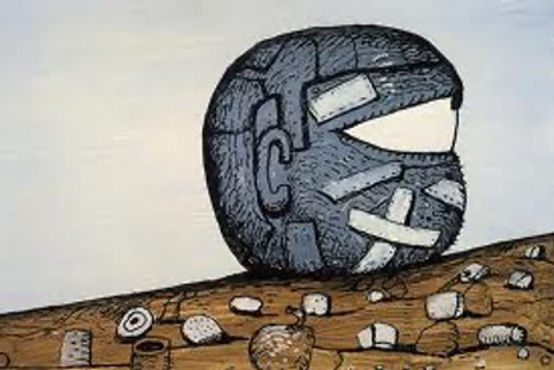
Untitled - 1980
The later paintings speak of the resoluteness of the human condition in the face of absurdity; the desperation and the inspiration, and are thus able to connect directly, viscerally, with the viewer.
‘This is art’s function: to switch our intensive register, to reconnect us with the world. Art opens us up to the non-human universe that we are part of’ (Sullivan, 2001, p. 128).
While it seems to make sense that art’s function is to switch our intensive register, and possibly to reconnect us to the world, it does not seem enough to open us up the non-human universe. The power of Guston’s later work comes from the human non-human world, the recognisable elements of the strangeness that Guston created; and if this link is cut there is the danger that art is set adrift to become invisible, inaccessible and irrelevant. Much modern art seems to have severed its connection with the human, but Guston’s work, whilst rooted in the human, paradoxically opens vistas of an unsettlingly odd ‘non-human universe’ by drawing on his perceptions and experiences. But it is not the human that is familiar and recognisable that acts as his source, but rather the human that is consciously unheard, and whose echoes reverberate around the dark and dripping caverns of the unconscious, insinuating themselves stealthily into the movements of the painter’s hand. Richter’s work too, whilst having a more cerebral conceptual base than Guston, is firmly rooted in the human, the familiar, the vernacular language of the photograph, and yet Richter develops a new familiar/unfamiliar language that occupies unfamiliar territory, a dimension slightly and disconcertingly disjunct, fractured, provoking the discomfort and need to change position that an osseous fracture in the body might provoke; the artist seeking the fracture in the body of work. Similarly, in the ontology of the quantum object, it is not just the visible or the explicable that shapes our understanding and perception of reality, but the unseen possibilities that seethe and struggle underneath the illusionary ordering and solidity that is on show in the gallery of the everyday. If philosophy is literally the love of wisdom, Guston’s paintings seem to also encompass a philagnoia, a love of ignorance; not in a philistine way (Guston was extremely well-read), but as a starting point of exploration, for the creation of the new; not to add to knowledge but to create uncertainty, questioning. And here, perhaps lies the small fracture between knowledge and understanding that separates the rational from the emotional, the analysis from the synthesis; the crevasse wherein art’s noumenon lurks, that can only lose, in ever-fading echoes, the voice of reason that shouts insistently into the darkness, and which returns the language of the unfathomable.
Bibliography
Adrian Rifkin, G. D. (1999). Gerard Fromanger - La Peinture Photogenique. London, UK: Black Dog Publishing.
Benjamin, A. (2004). Disclosing Spaces: On Painting. Manchester, UK: Clinamen Press.
Benjamin, A. (1996). What is Abstraction? London, UK: Academy Edition.
Benjamin, W. (2008). The Work of Art in the Age of Mechanical Reproduction. In The Work of Art in the Age of Mechanical Reproduction (J. Underwood, Trans.). London, UK: Penguin Books.
Benjamin, W. (2008). The Work of Art in the Age of Mechanical Reproduction. In W. Benjamin, The Work of Art in the Age of Mechanical Reproduction (J. Underwood, Trans.). London, UK: Penguin.
Bois, Y.-A. (1990). The Task of Mourning. In Y.-A. Bois, Painting as Model. Cambridge, MA, USA: MIT Press.
Crow, T. (2009). Hand-Made Photographs and Homeless Representation. In B. H. Buchloh (Ed.), October Files 8 - Gerhard Richter (Vol. 8). Cambridge, MA, USA: The MIT Press.
Crow, T. (2009). Hand-Made Photographs and Homeless Representation (Vol. 8). (B. H. Buchloh, Ed.) Canbridge, USA: The MIT Press.
Crow, T. (2009). Hand-Made Photographs and Homeless Representation. In B. H. Buchloh (Ed.), October Files 8 - Gerhard Richter (Vol. 8). Cambridge, MA, USA: The MIT Press.
Crow, T. (2001). Saturday Disasters:Trace and Reference in Early Warhol. In A. Michelson (Ed.), October Files - Andy Warhol. Cambridge, MA, USA: The MIT Press.
Danto, A. C. (2009). Andy Warhol. Newhaven, CT, USA: Yale University Press.
Desmet, R. (2010). Whitehead's Principle of Relativity. Retrieved from vub.academia.edu: http://vub.academia.edu/RonnyDesmet/Papers/228067/Whiteheads_Principle_of_Relativity
Duve, T. d. (1994). When Form Has Become Attitude - And Beyond. In N. d. Foster (Ed.), The Artist and the Academy(pp. 23-40). Southampton, UK: John Hansard Gallery.
Epperson, M. (2004). Quantum Mechanics and the Philosophy of Alfred North Whitehead. New York, NY, USA: Fordham University Press.
Fairbrother, T. Skulls. In G. Garrels (Ed.), The Work of Andy Warhol. Lightning Source Inc.
Foster, H. (2001). Death in America. In A. Michelson (Ed.), October Files - Andy Warhol. Cambridge, MA, USA: The MIT Press.
Heidegger, M. On the Origin of the Work of Art. In M. Heidegger, & D. Farrell (Ed.), Basic Writings. New York, NY, USA: HarperCollins.
Jean-Philippe Antoine, G. K. Gerhard Richter. Paris, France: Editions Des Voir.
Joyce, J. (1939). Finnegan's Wake. London, UK: Penguin Books.
Kelly, M. (2009). The Richter Effect. In J. J. Francis Halsall (Ed.), Rediscovering Aesthetics. Stanford, CA, USA: Stanford University Press.
Lyotard, J.-F. (1990). Duchamp's Transformers. Los Angeles, CA, USA: Lapis Press.
Massumi, B. (2011). Semblance and Event. Cambridge, MA, USA: MIT Press.
McCormack, P. (2007). Becomings-cunt. In J. Russell (Ed.), Frozen Tears. Birmingham, UK: ARTicle Press.
Meinhardt, J. (2009). Illusionism in Painting and the Punctum of Photogrpahy. In B. H. Buchloh (Ed.), October Files 8 - Gerhard Richter. Cambrudge, MA, USA.
Osborne, P. (2009). Abstract Images:Sign, Image and Aesthetic. In B. H. Buchloh (Ed.), October Files 8 - Gerhard Richter. Cambridge, MA, USA.
Osborne, P. (2009). Abstract Images:Sign, Image and Aesthetic in Gerhard Richter's Painting. In B. H. Buchloh (Ed.), October Files 8 - Gerhard Richter (Vol. 8). Cambridge, MA, USA: The MIT Press.
Osborne, P. (1992 йил October). Gerhard Richter's Negatives. October (62), pp. 102-113.
Osborne, P. (1991). Modernism, Abstraction and the Return to Painting. In A. B. Osborne (Ed.), Thinking Art: Beyond Traditional Aesthetics. London, UK: Institute of Contemporary Arts.
Richter, G. (1995). The Daily Practice of Painting. (H.-U. Obrist, Ed., & D. Britt, Trans.) London: Thames and Hudson.
Storr, R. (2002). Gerhard Richter. New York, USA: Museum of Modern Art.
Sullivan, S. O. (2001, December). The Aesthetics of Affect rhinking art beyond representation. Angelaki Journal of the Theoretival Humanities .
Swenson, G. (1963 йил November). What is Pop Art? Interviews with Eight Painters. Art News .
Wray, W. (2006). Zen Buddhism Reflections for Every Day. London, UK: Arcturus Publishing Ltd.